
Door Won’t Lock Properly? Common Causes Before You Blame the Lock
When a door won’t lock properly, it’s natural to assume the lock itself has broken. In many cases, though, the real cause is the position of the door rather than the mechanism inside the lock. Forcing a key or repeatedly operating a lock under pressure to compensate can eventually cause genuine damage, so it’s worth understanding what’s actually going on before assuming the worst. This guide explains the common reasons a door won’t lock properly and when it’s time to bring in a professional.
Why Your Door Won’t Lock Properly
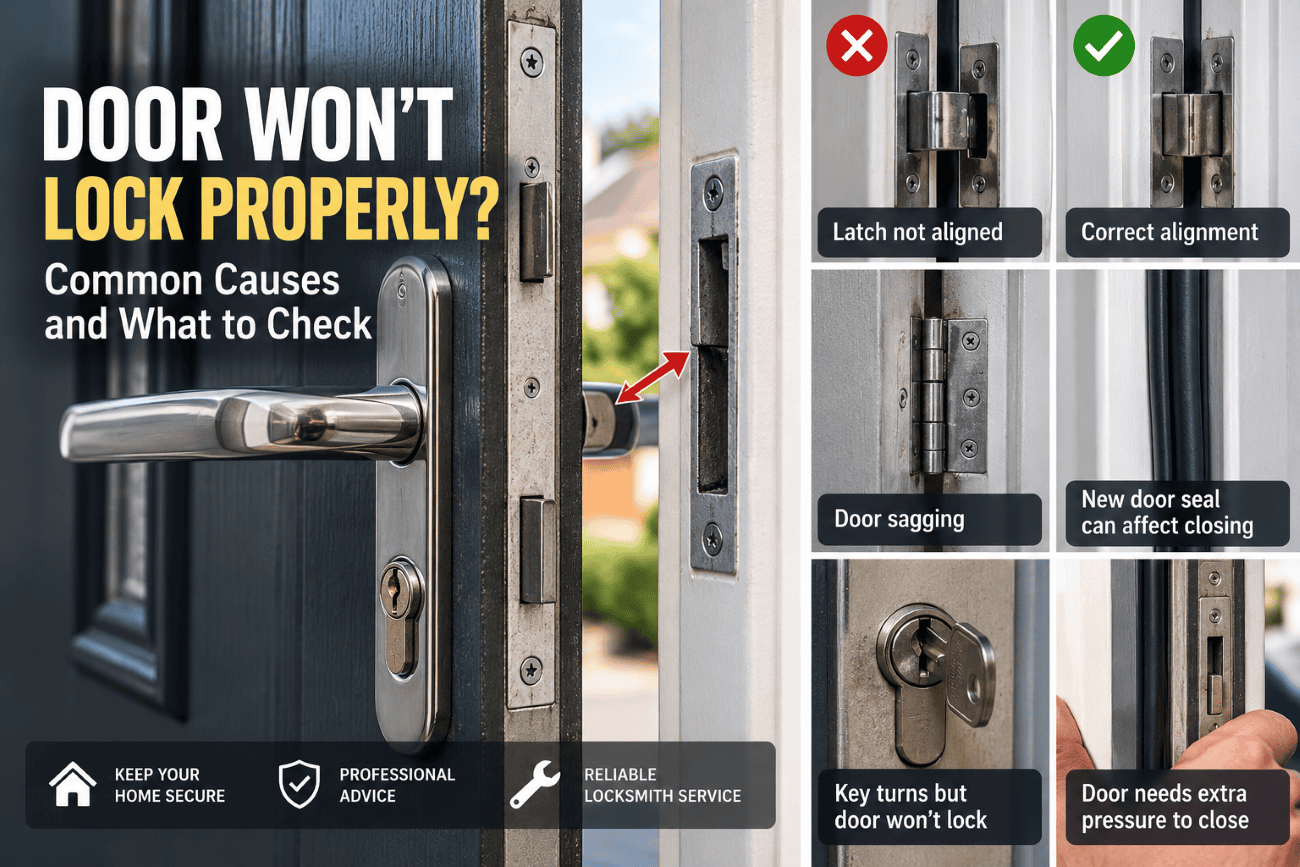
A locking system depends on several parts lining up correctly: the door itself, its hinges, the latch or bolt, the strike plate or keep, and the surrounding frame. When a door won’t lock properly, it’s often because one of these has shifted slightly out of position rather than because the lock has failed outright. If the door moves even a small amount relative to the frame, the bolt or latch may struggle to reach the keep cleanly, and the lock can feel stiff even though the internal mechanism is still working exactly as it should.
Door Sagging and Hinge Problems
Doors, particularly heavier timber or composite doors, can gradually sag over time. Hinges can develop a small amount of movement, regular use adds up, and seasonal changes in temperature and humidity can shift a door’s position slightly throughout the year. Homeowners often notice this through a specific set of symptoms: the door needs lifting slightly before it will lock, the latch doesn’t slide into the keep smoothly, the bolt only engages if pressure is applied to the door, or the key turns more easily when the door is pushed or pulled into place. These are signs worth paying attention to, but they’re not something to try to fix yourself. A professional assessment can confirm whether hinge adjustment or another form of realignment is needed.
New Weather Seals Can Change Door Alignment
A less obvious cause is a recent change to the door’s weatherstripping. Homeowners often install new draught seals or thicker weatherstripping to improve energy efficiency, but this can change how the door sits against the frame. A door that previously closed and locked normally may suddenly need extra pressure to shut properly. That additional pressure can affect latch engagement, locking bolts, euro cylinders, and multipoint locking systems alike. In these cases, the lock may not be the original cause of the problem at all, it’s simply responding to a door that now closes differently than it did before.
When the Key Turns but the Door Needs Pressure
One of the most useful diagnostic checks is comparing how the key behaves with the door open versus closed. If the key turns normally when the door is open but becomes difficult the moment the door is shut, this points to an alignment issue rather than a fault inside the lock. People often mistake this for a failing lock and assume replacement is needed, when in fact it’s a good reason to have the door’s alignment inspected first, before deciding that a full lock replacement is necessary.
Why Lubricating the Wrong Lock Is Not the Solution
When a lock starts to feel stiff, a common first reaction is to spray oil or whatever lubricant is nearby into the keyhole. This isn’t always the right response. Not every lubricant is suitable for lock mechanisms, and unsuitable products can attract dust and dirt, allowing contamination to build up inside the mechanism over time. Excessive lubrication can also mask the real problem temporarily, giving a false sense that the issue has been resolved. If the underlying cause is door alignment putting mechanical pressure on the lock, no amount of lubrication will correct that alignment. Understanding the actual cause is a better starting point than treating every stiff lock the same way.
Forcing a Stiff Lock Can Create a Bigger Problem
A door alignment problem tends to follow a predictable pattern if it’s left unaddressed: extra pressure builds on the locking components, the key becomes harder to turn, and the natural response is to force the key or handle to compensate. That forcing is where a manageable issue can turn into real damage to the lock’s internal components, and in some cases, a door that suddenly can’t be locked or unlocked at all. An early inspection, while the problem is still just an inconvenience, can prevent a routine alignment issue from turning into an emergency lockout.
When Should You Call a Locksmith?
It’s worth calling a locksmith when a key suddenly becomes difficult to turn, when the door needs excessive pressure to lock, when the lock works differently depending on whether the door is open or closed, when the latch or bolt doesn’t engage correctly, when the door has visibly dropped, when the locking mechanism feels unusually stiff, or when you find yourself repeatedly forcing the key or handle to get the door to lock. A professional locksmith can determine whether the issue involves door alignment, lock adjustment, a genuine lock repair, damaged components, or whether lock replacement is actually needed. The principle is straightforward: diagnose first, and only replace what genuinely needs replacing.
Lock Repair or Replacement?
Replacement isn’t always the first or best solution. If the mechanism itself has been damaged, replacement may well be appropriate, and a fresh lock installation can also be a good opportunity to correct alignment issues on an older door at the same time. But if the problem comes primarily from the door’s alignment rather than the lock, replacing the lock without addressing the underlying cause is unlikely to solve anything, since a new lock installed on the same misaligned door will face exactly the same pressure. It’s a similar principle to the one we cover in our guide on a key that won’t turn in the lock, where the fault isn’t always where it first appears to be. For a related but distinct issue, our article on a mortice lock that turns but won’t open covers what happens when the internal mechanism itself has developed a fault rather than the door.
Don’t Ignore Early Signs of a Door Alignment Problem
A stiff lock does not automatically mean a broken lock. The earlier the real cause is identified, whether that’s door alignment, a worn hinge, a new seal, or a genuine mechanical fault, the better the chance of preventing unnecessary damage and avoiding an emergency situation. If a door has become difficult to lock, the safest next step is a professional assessment rather than continuing to force it. If you can’t wait, an emergency locksmith can attend and assess the door and lock together. It’s also worth checking that whoever you call holds a valid licence from the Private Security Authority, Ireland’s regulator for the security industry. To arrange an assessment, contact AutoKeyMaster, or browse more locksmith advice for related guidance.
Frequently Asked Questions
Why won't my door lock properly even though the key still works?
This usually points to door alignment rather than a lock fault. The bolt or latch may not be lining up cleanly with the keep due to a shift in the door or frame.
Can new weather seals affect how a lock works?
Yes. Thicker or firmer seals can change how the door sits against the frame, adding pressure that affects the latch, bolt or multipoint locking system.
Should I lubricate a stiff lock myself?
Not automatically. If the stiffness comes from door alignment rather than a dry mechanism, lubrication won't fix the underlying cause and can attract dirt over time.
Does a door that won't lock properly always need a new lock?
No. Many cases are resolved by correcting the door's alignment rather than replacing the lock itself.